How to Calculate CAC (Customer Acquisition Cost)
Short answer: CAC = total sales and marketing cost ÷ new customers acquired in the same period. The mistake most people make is only counting ad spend. True CAC includes salaries, software, agency fees, and creative costs — everything it took to win those customers.
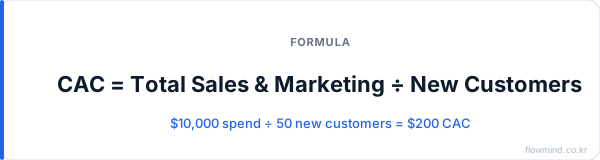
Use this diagram on your site (free): copy the embed code below — a credit link back to FlowMind is appreciated.
The CAC formula
- CAC = Total sales & marketing cost ÷ New customers acquired
- Example: $10,000 total cost ÷ 50 new customers = $200 CAC
Pick a consistent time period (monthly or quarterly) and count both the spend and the customers within that same window.
What to include in “total cost”
This is where most CAC calculations go wrong. A proper, fully loaded CAC includes:
- Ad spend — Google, Meta, and all paid channels
- Salaries — the portion of marketing and sales team pay tied to acquisition
- Software & tools — ad platforms, CRM, analytics, landing page builders
- Agency & freelancer fees — management, creative, copywriting
- Creative production — video, photography, design
A simple “ad spend ÷ customers” figure is really closer to CPA. Fully loaded CAC is almost always higher — and it’s the number investors and finance teams care about.
CAC vs CPA — what’s the difference?
- CPA — usually the cost of a conversion (lead, signup, or sale), often measured per channel using ad spend only
- CAC — the fully loaded cost to acquire a paying customer, blended across all channels and including overhead
Use CPA to optimise individual campaigns. Use CAC to evaluate whether your overall business model is sustainable. See CPA vs CAC for a deeper comparison.
Blended CAC vs paid CAC
- Blended CAC = total cost ÷ all new customers (including organic, referral, word-of-mouth). Shows your true average cost.
- Paid CAC = paid acquisition cost ÷ customers from paid channels only. Shows how efficient your paid marketing is in isolation.
Track both. Blended CAC tells you the real picture; paid CAC tells you whether your ad engine is working.
What makes a good CAC?
CAC only means something relative to customer lifetime value. The benchmark is the LTV:CAC ratio:
- 3:1 or higher — healthy; you earn at least 3x what it costs to acquire a customer
- 1:1 — you’re breaking even on acquisition with no margin for operations
- 5:1+ — you may be under-investing in growth and could scale faster
See the LTV:CAC ratio explained and CAC payback period. Run your own numbers with the LTV:CAC calculator.
Common mistakes
- Only counting ad spend. This understates CAC and creates a false sense of profitability.
- Mismatched time periods. If customers acquired this month came from last month’s spend (long sales cycles), align your periods or use cohort analysis.
- Counting all conversions as customers. A lead is not a customer. CAC counts paying customers, not signups.
- Ignoring CAC payback. A $200 CAC is fine if customers pay $50/month and stay a year — but cash flow matters. Track how long it takes to recover CAC.
FAQ
How often should I calculate CAC?
Monthly for operational tracking, quarterly for strategic review. Watch the trend over time more than any single month’s number.
Should CAC include the cost of retaining customers?
No. CAC is strictly about acquisition. Retention and expansion costs are tracked separately and feed into LTV, not CAC.
Why is my CAC rising?
Common causes: rising CPCs, audience saturation, declining conversion rate, or scaling into lower-intent audiences. Diagnose which by checking CPC, conversion rate, and channel mix separately.