Facebook Ads vs Google Ads: Which Should You Use?
Short answer: Google Ads captures people who are already searching for what you sell. Facebook Ads reaches people who aren’t searching yet but match your ideal customer. Different jobs, different platforms — most growing businesses need both.
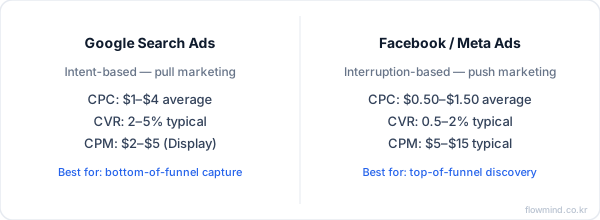
Use this diagram on your site (free): copy the embed code below — a credit link back to FlowMind is appreciated.
The fundamental difference
This is the single most important thing to understand before choosing a platform:
- Google Search Ads = pull marketing. Someone types “buy running shoes size 10” and your ad appears. They’re already in buying mode. You’re capturing demand that already exists.
- Facebook/Meta Ads = push marketing. You interrupt someone mid-scroll with an ad for running shoes. They weren’t looking, but they might be interested. You’re creating demand.
This distinction drives almost every difference in how the two platforms perform: CTR, conversion rate, CPC, and which campaigns work best where.
CPC comparison
- Google Search Ads: $1–$4 average across all industries. Legal and finance keywords routinely hit $10–$50+. See how much do Google Ads cost.
- Facebook/Meta Ads: $0.50–$1.50 average for most industries. Finance reaches $3–$5. See Facebook Ads CPC benchmarks.
Facebook is typically cheaper per click — but cheaper clicks don’t automatically mean cheaper customers. Because Facebook traffic is lower-intent, it often converts at a lower rate.
Conversion rate comparison
- Google Search: 2–5% average conversion rate across industries. High-intent searches (“buy X now”) can reach 8–12%.
- Facebook/Meta: 0.5–2% average conversion rate. Retargeting audiences convert significantly higher (2–5%).
Do the math: a $1 CPC with 4% conversion rate gives a $25 CPA. A $0.60 CPC with 0.8% conversion rate gives a $75 CPA. The platform with cheaper clicks often ends up with a higher CPA.
When to use Google Ads
- People are already searching for your product or service (“best project management software”, “plumber near me”)
- You need leads or sales quickly — Google Search captures people at the bottom of the buying funnel
- You’re in a service category with clear, searchable intent (legal, medical, home services, B2B software)
- You have a limited budget and want the highest-intent clicks possible
When to use Facebook Ads
- Your product needs to be seen to be wanted — visual products like clothing, home decor, or food
- You’re building brand awareness or entering a new market where demand doesn’t exist yet
- You want to retarget website visitors who didn’t convert on Google (remarketing is where Facebook shines)
- Your audience has specific demographic or interest profiles that Facebook can target precisely
Which to start with (if you have limited budget)
If there’s existing search demand for what you sell, start with Google Search. It captures ready buyers and typically produces faster results. Once you have conversion data and a pixel populated, add Facebook for retargeting and prospecting.
If there’s little or no search volume for your product — maybe you’re creating a new category — start with Facebook to build awareness, then add Google branded search later as recognition grows.
The combined strategy (what most successful brands do)
- Google Search — capture existing demand, close intent-based buyers
- Facebook prospecting — reach new audiences, build brand awareness at scale
- Facebook retargeting — re-engage people who visited from Google but didn’t convert
- Google branded search — capture people who saw your Facebook ad and then searched your brand name
Measure the combined efficiency with MER (marketing efficiency ratio) rather than platform-level ROAS, which overcounts cross-channel conversions.
Common mistakes
- Judging Facebook by Google’s conversion rates. They’re different audience temperatures. Expecting 4% CVR from cold Facebook traffic is unrealistic.
- Running brand awareness on Google Search. Google Search is expensive; using it for generic brand awareness wastes money. Use Google Display or YouTube for brand awareness instead.
- Comparing CPA across platforms without accounting for attribution overlap. Both platforms often claim credit for the same conversion. Always cross-reference with your actual revenue data.
FAQ
Is Google Ads more expensive than Facebook?
Per click, usually yes. But the relevant comparison is cost per customer (CPA), not cost per click. Because Google Search intent is higher, the CPA is often comparable or lower despite higher CPCs.
Can I run both at the same time with a small budget?
$500/month or less: pick one and do it well. Split budget is too thin for either platform to optimise. $1,000–$3,000/month: Google Search first, add Facebook retargeting once pixel data builds. $3,000+/month: run both in earnest.
Which platform has better targeting?
Facebook has richer demographic and interest targeting. Google has better intent targeting (people telling you what they want via search queries). Both have improved significantly with AI-based audience targeting in recent years.